Showing posts with label France. Show all posts

Wednesday, 19 September 2012

Palace of Versailles, Versailles - Île-de-France


The Château de Versailles, which has been on UNESCO’s World Heritage List for 30 years, is one of the most beautiful achievements of 18th-century French art. The site began as Louis XIII’s hunting lodge before his son Louis XIV transformed and expanded it, moving the court and government of France to Versailles in 1682. Each of the three French kings who lived there until the French Revolution added improvements to make it more beautiful.


The Hall of Mirrors, the King’s Grand Apartments, the Museum of the History of France. The Château de Versailles, the seat of power until 1789, has continued to unfurl its splendour over the course of centuries. Originally a humble hunting lodge built by Louis XIII. Louis XIV chose the site to build the palace we know today, the symbol of royal absolutism and embodiment of classical French art.

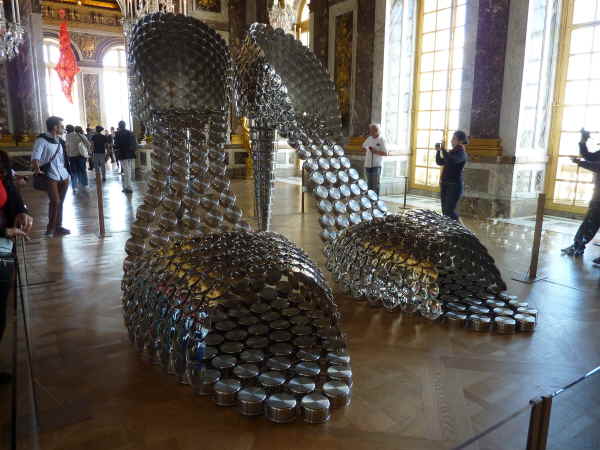
These shoes are made from stainless steel saucepans and lids.
From the central window of the Hall of mirrors the visitor look down on the grand perspective that leads the gaze from the Water Parterre to the horizon. This original perspective, which preceded the reign of Louis XIV, was developed and prolonged by the gardener André Le Nôtre by widening the Royal Path and digging the Grand Canal. This vast perspective stretches
from the façade of the Château de Versailles to the railings of the park.

Planning to visit the house and gardens then you need to get there as early as possible.
Would suggest you buy your ticket before hand. If you do have to buy tickets on the day allow extra time as the cues can be long. While there is a ticket office you can get your tickets from an auto ticket machine using cash or credit card. This does include an audio guide if you are visiting the palace and apartments.
While you cannot take food/drink into the palace there are a couple of restaurant style places to eat. They don't object taking a small bottle of water but you will need to have your bags scanned etc. 

Thursday, 2 August 2012

Arras - Nord-Pas-de-Calais - Pas-de-Calais - France

Arras - Nord-Pas-de-Calais - Pas-de-Calais - France


A town fought over by many countries since it's tribal beginnings
and being made a garrison town by the Romans.

The modern town of Arras initially grew up around the abbey as a grain market. Both town and abbey suffered during the 9th century from the attacks of the Vikings, who later settled to the west in Normandy.
The centre of the town is marked by two large squares, the Grande Place and the Place des Héros, also called the Petite Place. These are surrounded by buildings largely restored to their pre-war World War I conditions.

The town's people were converted to Christianity in the late 4th century by Saint Inoccent, who was killed in 410 during a barbarian attack on the town. Around 130 years later, Saint Vedast (also known as Saint Vaast) established in the town and a monastic community, which developed during the Carolingian period into the immensely wealthy Benedictine Abbey of St. Vaast.


The Abbey of St Vaast is now host to a museum of fine art and artefacts.

Offering overview of the French, Flemish and Dutch paintings as well as porcelain.
On display are also is Napoleon's royal coach ornamented with gold and emblazoned with a capital N, 


drawn by eight horses, and bearing the Emperor dressed in purple velvet embroidered with gems and gold.


During the First World War, major battles occurred here such as the famous “Battle of Arras”.


The famous underground passages of Arras, called “Boves”, were used to shelter the civilians, and the British soldiers launched a successful attack against the German army from there.


In the Second World War, during the invasion of France in May 1940, the town was the focus of a major British counter attack. The town was occupied by the Germans and 240 suspected French Resistance members were executed in the Arras citadel.

Tuesday, 31 July 2012

Dijon - France

Dijon - Bourgogne - Côte-d'Or - France


Famed for it's mustard, Dijon has more to offer thanks to it's medieval sites. This province was home to the Dukes of Burgundy from the early 11th until the late 15th centuries. Dijon was a place of tremendous wealth and power and one of the great European centers of art, learning and science. The Duchy of Burgundy was a key in the transformation of medieval times toward early modern Europe. 


The Palais des ducs de Bourgogne (Palace of the Dukes of Burgundy) now houses city hall and a museum of medieval art.


There is a new tramway network in progress due to be up and running in August.

Monday, 9 April 2012

DFDS Ferry Terminal Dunkirk

Terminal Roulier du Port Ouest, F-59279 Loon-Plage (Dunkirk).
 GPS coordinates: 51º01.261N 002º11.868E.
  •  Directions: From A25 Lille: Join the A16, direction Calais. 
  • From A16 Dunkerque/Belgium: Take exit 53 (24). 
  • Follow signs ‘Port Rapide/Car Ferry’. 
  • From St Omer: The D600 crosses the A16 direct to the Terminal. 
  • From Dunkerque Centre: Follow signs for Calais - either A16 to exit 53 (24) or on RN1 follow signs to ‘Loon Plage/Car Ferry’
Plan to eat or get refreshments before you get here, unless you like vending machine items.
There is a lift available if you go through the doors just to the right of the staircase that takes you up the reception area.

You can tell you are going back to the UK.
(c) 2012 Lloyd Arrow


Sunday, 1 April 2012

Masseret - France

This is the Repunsels Tower

Built as a cross between a water tower and a folley
Free to enter, amazingly you collect the large key from the reception at  Hotel de la Tour. The is plenty of free parking.
The spiral staircase is wide and solid. Whilst you can look out the windows they cannot open.
The panoramic view from the top allows you to see for miles. As far as the motorway.
If your passing and have time for a break then give it a visit, oh and don't forget to give the key back.


Info spot - English

A modest family name appears in the twelfth century Masseret, and the presence of a castle atop the hill of the village is attested in the thirteenth Century, it is indeed in the late Middle Ages as a show Masseret replaces as chief - instead of a chatellenie controlled by the Viscount of Limoges.
The castle included a tower and main building, protected by a septic system.
The position of this fortress, commanding the passage between Upper and Lower Limousin, was essential during the Hundred Years War.

Info spot - French

Une modeste famille du nom de Masseret apparait au XIIe siecle, et la presence d’un chateau au sommet de la colline du bourg est attestee des le XIIIe Siecle; c’est en effet au bas Moyen age que Masseret se substitue a Salon comme chef-lieu d’une chatellenie controlee par le Vicomte de Limoges.
Le chateau incluait une tour quadrangulaire et un corps de logis, proteges par un systeme de fosses.
La position de cette forteresse, commandant le passage entre  Haut et Bas Limousin, fut essentielle au moment de la Guerre de Cent Ans.

Friday, 30 March 2012

Mirepoix - France

This is a town steeped im history. A town while not built around a town square as such or a bastide like a lot of historic French towns,it does follow the same principles. The other difference being the central houses are arranged lengthways so that each may a frontage onto the square.


Before the existance of the buildings on each side of the corn exchangethis was a vast space covered with covered arcades. 
There are a number of plaques located around the town to help you with it's facts


The cathedral of St Maurice whose foundation stone was laid in 1298 was not completed as it seen today until the 19th centuary. The one span knave of 22 metres is believed one of the biggest in Europe.

Monday, 26 March 2012

Objat, Corrèze, Limousin - France

The town has a Sunday market from. 09:30 - 12:30 for which the main road through the town is closed. However there are plenty of places to park. Around the town hall and if you come in on the road with big wine bottle outside, there is parking on the right. The market itself has all the usual fresh fruit,veg,cheese and flowers. Along with clothes gifts and food stuffs. Make sure you go to the indoor area as well. 


Around the back of the town is a square and a lake. A nice place where you can have a picnic There a few cafes/bars to pop in for a drink.

Sunday, 25 March 2012

Brive-la-Gaillard, Corrèze, Limousin - France

Brive-la-Gaillard, Corrèze, Limousin

This is a walled town with many examples of medieval architecture, such as the Collégiale Saint Martin (built in 1180), the Chapelle Saint-Libéral (XIV and XVc) and the fourteenth century Quartier des Doctrinaires.  Brive-la-Gaillard is a market town, and in addition to the large weekly market, it hosts a flower market (place Latrelle), an annual onion market during the summer and truffle markets in winter.  One of the towns key events is a large book fair held in autumn.  Key museums in the town are the Labenche Museum of Arts and History, sited in a Renaissance building, Maison Edmond Michelet (a WWII museum), and the Denoix Distillery, a nineteenth century distillery famed for the local walnut liqueur.  The town has an 18 hole golf course, and not far away at Lissac is the Lac du Causse, a 100 hectare leisure lake with all kinds of water sports available.

Monday, 5 December 2011

Cité Europe, Calais - France

The gateway to the Channel Tunnel, Cite Europe is an international trade center. Both the mall and coastal tourist stage is a must for all those who cross the Channel, Cité Europe offers more than 140 shops, a hypermarket, 12 cinema halls and an incomparable "City Gourmet" which brings together some twenty restaurants.

The Gaumont cinema complex offers you 12 screens, including one Big Screen 20 @ meters, it is unique in the region. There are 4200 parking spaces and 50 spaces for coaches are available for free.

Contact & Information Regional Shopping Centre Cité Europe 1001 Boulevard du Kent 62902 Coquelles Cedex
 GPS Coordinates Latitude: 50.93452 Longitude: 1.80787

 Tel: 03 21 46 47 48 Fax: 03 21 85 21 10

Cite Europe decked for Christmas 

Gallery - Access map PDF format

Wednesday, 29 June 2011

Puilaurens Castle, Puilaurens-Lapradelle - Aude - France

Puilaurens Castle,  Puilaurens-Lapradelle - Aude - France

Cite du pay Cathare
Located approximately 500 metre above the town of Puilaurens is located one of the Cathare castles.
As you head up the road through a few bends there is a sharp right turn, lookout for the sign. Then up an winding roard and then a bend which has signpost saying parking. (Good photo point to look up at the castle). Carry on up to the main visitor car park. There are toilets  (nb: CA These are not hole in the ground) on the right and the visitor entrance and shop on your left.
The current entry fee is 4.00 euros per adult (June 2011)
Word of caution this is steep walk up a wooded path with only dirt and the root of the trees that line the path at the bottom, followed by uneven rock and gravel until you get the to stepped zig-zag trenches. The guide available in the language of your choice says that it takes 15-20 minutes to the main gate at the top. It took me 25 but did have a few stops on the way up. There are also a number on name tags indicating the various types of plants and trees.
Before you enter the main arched entrance take a look around at over 2072 acres of what was royal, mainly fir-tree forest. Now state owned there are other conifers such as beech, cedar and pine trees.

History

The village of Puilaurens-Lapradelle is actually made up of hamlet of Lavagnac and Puilaurens which gives it an area of some 7410 acres.
Archaeological human existence has been found in the cave under the river Boulzane dating back some 12000 years ago.
"Mont Ardu" the name of the mountain where the castle was built, appeared the first time in 958 in a charter which Lothraire cenceded to the abbey of Saint Michel de Cuxa the provostship of Puilaurens. This consists of the valley of Boulzane or Saint Croix.

The first of the lords of Puilaurens that we can identify with any certainty, Pierre Catala, appears as a witness in on Guillaume de Peyrepertuse in 1217. In 1229, Guillaume de Peyrepertuse commanded Puilaurens it withstood attack by Simon de Montfort and his successors until the end of the crusades. After 1243, its owner was Roger Catala, Pierre's son, but it was defended, like Quéribus, by Chabert de Barbaira, a Cathar military commander who was the last person to defend the Occitan cause.

The Cathars' presence in Puilaurens seems to be related to the role of refuge run by the fortress. In 1241, the Cathar deacon for Fenouilldès, Pierre Paraire stayed there and from 1245 - 1246 several Cathars lodged here

Is not known exactly when the castle came under royal control, but the annexation seems consumated around 1250. In a letter of August 1255, Saint Louis ordered the seneschal of Carcassonne to fortify the castle. The Treaty of Corbeil 1258 defines it as one of the main fortresses defending the border against Aragon.

In 1259 Puilaurens is occupied by a garrison commanded by Odon de Monteuil with a chaplain and 25 sergeants at arms. The castle was restored  around 1263, and again  under  Phillipe-le-Hardi (Philip the Bold) 1270 - 1285.

In its current state, the fortress essentially dates back to the start of the royal period in Languedoc and is not earlier than the thirteenth century.

Until the Treaty of the Pyrenees (1659), Puilaurens had to face repeated incursions from Spain. After the Treaty of the Pyrenees, Puilaurens was decommissioned and was no longer occupied other than by a small garrison of "mort-paid" (veterans).

If you like castles or interested in Cathar history, don't mind a bit of walk; then worth a trip for the view and historical value.

Additional information.
List of castles in France

Location

WGS84 42° 48′ 13.5″ N, 2° 17′ 58″ E
      42.80375, 2.299444

UTM 31T 442717 4739260


Sunday, 13 February 2011

Lille - France

Lille - France

Lille was born out of the water of the Deûle river, a slow-flowing tributary situated on a major route between the great Flemish towns and the Champagne fairs.

The town initially developed at a transhipment point on the Deûle, which required boats to be unloaded until they reached a more navigable section of the river. The town’s origins were therefore as a port, which preceded its role as a merchant town.

Most of the main historical features of the city are based around the square. See the Lille Tourist Information Office.
If you are planning a visit and driving then it pays to park just on the outskirts and get the Lille Metro  - Transpole
They offer free parking 24/7 and security surveillance Monday - Saturday: 6 am - midnight. They are located in Lille (metro stops Porte d'Arras, Porte des Postes and CHR B Calmette), in Lomme (metro stop Saint-Philibert) and in Villeneuve d'Ascq (metro stops Les Prés and 4 Cantons).


A one way ticket from CHR B Calmette to Rihour 1.40 Euro, buying your ticket from a machine. You can use a credit card or coins but there are no options to use notes.
After collecting your ticket you will need to get it punched for verification at the points just before the platform.
One point to note, is that this an automated underground train. It has no driver and is all computer controlled, trains running running every 2 - 3 minutes.
Taking 22 minutes to get from one end of the line to the other.

Check car park location
vincipark.com
Sample ticket, after being validated


View Larger Map

Tuesday, 4 January 2011

France - Holiday letting & rental

Looking at Holiday Villas and Apartments for Rental in France recently.
Here are some good web sites, covering all locations, not just France.

      http://www.ownersdirect.co.uk/


http://www.holiday-rentals.co.uk/


https://www.novasol.com/


http://www.holidaylettings.co.uk/


Sunday, 30 May 2010

Perpignan - France May 2010

And so the journey begins. Eurotunnel UK being the first point of call.
The mission for the trip is to take a look at the properties and area of France to obtain a house. 


Itinerary for May/June

Visit points:-

4 Eurotunnel UK
4 ETAP hotel Chateauroux Déols
4Chateau de Lacomte
4 ETAP Hotel Perpignan Nord
4 Quillan4Axat


Also various locations in the area to be updated
En France


View Larger Map


ETAP Perpignan Nord (Rivesaltes)
39.60 EUR for a standard room
Double bed, Bunk bed, Shower, Toilet and TV
4.70 EUR Buffet breakfast P/P

Thursday, 15 April 2010

Andorra - France

Andorra is one of the tax havens of France. The Principality being formed in 1278
It is a prosperous country mainly because of its tourism industry, having some 10.2 million visitors a year.


Apart from the shops, restaurants and cinemas there is lots to do
Attractions include:-
4Tax free shopping
4Skiing
4 Pubs
4Walking
4Shops
4Restaurants
4Guided tours


Be aware that if you do buy your Duty Free shopping that your stick to your EU limits. You may be stopped on the way back to your accommodation.
They are building a new border control post.


View Larger Map

Approxamately  3 to 4 hours from Perpignan,  3 hours from Carcassonne


Weather - Andorra

Monthly averages °C


JanuaryAvg low: 1°Avg hi: 10°Avg precip: 5.27 cm
FebruaryAvg low: 2°Avg hi: 11°Avg precip: 4.32 cm
MarchAvg low: 4°Avg hi: 14°Avg precip: 4.31 cm
AprilAvg low: 5°Avg hi: 16°Avg precip: 7.6 cm
MayAvg low: 9°Avg hi: 19°Avg precip: 6.46 cm
JuneAvg low: 12°Avg hi: 22°Avg precip: 4.99 cm
JulyAvg low: 14°Avg hi: 25°Avg precip: 3.39 cm
AugustAvg low: 14°Avg hi: 26°Avg precip: 4.62 cm
SeptemberAvg low: 12°Avg hi: 23°Avg precip: 5.46 cm
OctoberAvg low: 8°Avg hi: 19°Avg precip: 5.33 cm
NovemberAvg low: 4°Avg hi: 13°Avg precip: 5.73 cm
DecemberAvg low: 2°Avg hi: 11°Avg precip: 5.12 cm
Weather information supplied by: weather.msn.com 

Transport -
Airports - Perpignan-Rivesaltes (Llabanère) Airport (PGF)
           Carcassonne Airport (CCF)
                      Gerona, Spain (GRO)
Bus -
Car - Le Havre <> Andorra (10-11 hrs approx drive time)
Train - Paris/Ile-de-France <> Montpellier <> Perpignan (TGV & SNCF)


à bientôt