Sunday, 25 March 2012
Brive-la-Gaillard, Corrèze, Limousin - France
Brive-la-Gaillard, Corrèze, Limousin
This is a walled town with many examples of medieval architecture, such as the Collégiale Saint Martin (built in 1180), the Chapelle Saint-Libéral (XIV and XVc) and the fourteenth century Quartier des Doctrinaires. Brive-la-Gaillard is a market town, and in addition to the large weekly market, it hosts a flower market (place Latrelle), an annual onion market during the summer and truffle markets in winter. One of the towns key events is a large book fair held in autumn. Key museums in the town are the Labenche Museum of Arts and History, sited in a Renaissance building, Maison Edmond Michelet (a WWII museum), and the Denoix Distillery, a nineteenth century distillery famed for the local walnut liqueur. The town has an 18 hole golf course, and not far away at Lissac is the Lac du Causse, a 100 hectare leisure lake with all kinds of water sports available.
Labels:
Brive-la-Gaillard,
Corrèze,
France,
Limousin
Location:
Brive-la-Gaillarde, France
Saturday, 24 March 2012
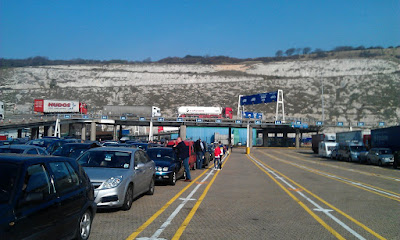
DFDS Eastern dock Dover
Location:
N Exit Rd, Dover, Kent CT16, UK
Monday, 5 December 2011
Cité Europe, Calais - France
The gateway to the Channel Tunnel, Cite Europe is an international trade center.
Both the mall and coastal tourist stage is a must for all those who cross the Channel, Cité Europe offers more than 140 shops, a hypermarket, 12 cinema halls and an incomparable "City Gourmet" which brings together some twenty restaurants.
The Gaumont cinema complex offers you 12 screens, including one Big Screen 20 @ meters, it is unique in the region. There are 4200 parking spaces and 50 spaces for coaches are available for free.
Contact & Information Regional Shopping Centre Cité Europe 1001 Boulevard du Kent 62902 Coquelles Cedex
GPS Coordinates Latitude: 50.93452 Longitude: 1.80787
Tel: 03 21 46 47 48 Fax: 03 21 85 21 10
Cite Europe decked for Christmas
Gallery - Access map PDF format
The Gaumont cinema complex offers you 12 screens, including one Big Screen 20 @ meters, it is unique in the region. There are 4200 parking spaces and 50 spaces for coaches are available for free.
Contact & Information Regional Shopping Centre Cité Europe 1001 Boulevard du Kent 62902 Coquelles Cedex
GPS Coordinates Latitude: 50.93452 Longitude: 1.80787
Tel: 03 21 46 47 48 Fax: 03 21 85 21 10
Cite Europe decked for Christmas
Gallery - Access map PDF format
Labels:
Calais,
Cité Europe,
France
Thursday, 1 December 2011
Lille - France
Lille Christmas Market
Open every day from 11:00 - 20:00 19th November - 30th December
Closed 25th December
With approximately 80 wooden chalets in the winter wonderland. All the usual european christmas market goodies plus some unusual items as well
Place du General de Gaulle host the large ferris wheel. Costing 4 Euros per adult. We had some 6 trips around. So if you think it's just a couple of circuits and that is the end of the ride. Think again.
The views across the top of the city are great and I would recommend a giving it a go.
Closed 25th December
With approximately 80 wooden chalets in the winter wonderland. All the usual european christmas market goodies plus some unusual items as well
The views across the top of the city are great and I would recommend a giving it a go.
Sunday, 2 October 2011
Lulworth Castle & Lulworth House, Dorset
Lulworth Castle & Lulworth House - Dorset - England
Lulworth Castle, in East Lulworth, Dorset, situated south of Wool, is an early 17th century mock castle. The stone building has now been renovated as a museum.
In 1610 Lulworth Castle was built as a hunting lodge by Thomas Howard, 3rd Lord Bindon, who was the son of the 2nd Duke of Norfolk. In 1641, Humphrey Weld purchased it from Howard. A chapel was built in 1786. Following the French Revolution, the surviving members of the French Royal Family were allowed to use Lulworth as one of their residences-in-exile.
The castle was gutted by fire in 1929 and was left as a roofless ruin, the family building a new residence for themselves nearby. In the 1970s, restoration work begun with the help of the English Heritage.
If you are driving there then I would suggest using a sat nav. Then use co-ordinates 50.63613, -2.20402 rather than the post code otherwise you may possibly end up at the back of the estate.
View Larger Map
Lulworth Castle, in East Lulworth, Dorset, situated south of Wool, is an early 17th century mock castle. The stone building has now been renovated as a museum.
In 1610 Lulworth Castle was built as a hunting lodge by Thomas Howard, 3rd Lord Bindon, who was the son of the 2nd Duke of Norfolk. In 1641, Humphrey Weld purchased it from Howard. A chapel was built in 1786. Following the French Revolution, the surviving members of the French Royal Family were allowed to use Lulworth as one of their residences-in-exile.
The castle was gutted by fire in 1929 and was left as a roofless ruin, the family building a new residence for themselves nearby. In the 1970s, restoration work begun with the help of the English Heritage.
If you are driving there then I would suggest using a sat nav. Then use co-ordinates 50.63613, -2.20402 rather than the post code otherwise you may possibly end up at the back of the estate.
View Larger Map
Labels:
Dorset,
England,
Lulworth Castle
Location:
B3070, East Lulworth, Dorset BH20 5, UK
Wednesday, 7 September 2011
Highclere Castle - Downton Abbey
Highclere Castle is a country house in high Elizabethan style, with park designed by Capability Brown. The 1,000 acre estate once part of much larger estate is in the English Highclere Park, Newbury RG20 9RN. It is the country seat of the Earls of Carnarvon, a branch of the Anglo-Welsh Herbert family.
The TV series Downton Abbey filmed at Highclere Castle is set in an Edwardian country house in 1912. It portrays the lives of the Crawley family and the servants who work for them.
The Crawleys have been the Earls of Grantham since 1772. In the drawing rooms, library and beautiful bedrooms, with their tall windows looking across the park, live the family, but below stairs are other residents, the servants, who are as fiercely possessive of their ranks as anyone above.
(Image copyright ITV)
The TV series Downton Abbey filmed at Highclere Castle is set in an Edwardian country house in 1912. It portrays the lives of the Crawley family and the servants who work for them.
The Crawleys have been the Earls of Grantham since 1772. In the drawing rooms, library and beautiful bedrooms, with their tall windows looking across the park, live the family, but below stairs are other residents, the servants, who are as fiercely possessive of their ranks as anyone above.
(Image copyright ITV)
Labels:
Downton Abbey,
England,
Highclere Castle
Wednesday, 29 June 2011
Puilaurens Castle, Puilaurens-Lapradelle - Aude - France
Cite du pay Cathare
Located approximately 500 metre above the town of Puilaurens is located one of the Cathare castles.
As you head up the road through a few bends there is a sharp right turn, lookout for the sign. Then up an winding roard and then a bend which has signpost saying parking. (Good photo point to look up at the castle). Carry on up to the main visitor car park. There are toilets (nb: CA These are not hole in the ground) on the right and the visitor entrance and shop on your left.
The current entry fee is 4.00 euros per adult (June 2011)
Word of caution this is steep walk up a wooded path with only dirt and the root of the trees that line the path at the bottom, followed by uneven rock and gravel until you get the to stepped zig-zag trenches. The guide available in the language of your choice says that it takes 15-20 minutes to the main gate at the top. It took me 25 but did have a few stops on the way up. There are also a number on name tags indicating the various types of plants and trees.
Before you enter the main arched entrance take a look around at over 2072 acres of what was royal, mainly fir-tree forest. Now state owned there are other conifers such as beech, cedar and pine trees.
History
The village of Puilaurens-Lapradelle is actually made up of hamlet of Lavagnac and Puilaurens which gives it an area of some 7410 acres.
Archaeological human existence has been found in the cave under the river Boulzane dating back some 12000 years ago.
"Mont Ardu" the name of the mountain where the castle was built, appeared the first time in 958 in a charter which Lothraire cenceded to the abbey of Saint Michel de Cuxa the provostship of Puilaurens. This consists of the valley of Boulzane or Saint Croix.
The first of the lords of Puilaurens that we can identify with any certainty, Pierre Catala, appears as a witness in on Guillaume de Peyrepertuse in 1217. In 1229, Guillaume de Peyrepertuse commanded Puilaurens it withstood attack by Simon de Montfort and his successors until the end of the crusades. After 1243, its owner was Roger Catala, Pierre's son, but it was defended, like Quéribus, by Chabert de Barbaira, a Cathar military commander who was the last person to defend the Occitan cause.
The Cathars' presence in Puilaurens seems to be related to the role of refuge run by the fortress. In 1241, the Cathar deacon for Fenouilldès, Pierre Paraire stayed there and from 1245 - 1246 several Cathars lodged here
Is not known exactly when the castle came under royal control, but the annexation seems consumated around 1250. In a letter of August 1255, Saint Louis ordered the seneschal of Carcassonne to fortify the castle. The Treaty of Corbeil 1258 defines it as one of the main fortresses defending the border against Aragon.
In 1259 Puilaurens is occupied by a garrison commanded by Odon de Monteuil with a chaplain and 25 sergeants at arms. The castle was restored around 1263, and again under Phillipe-le-Hardi (Philip the Bold) 1270 - 1285.
In its current state, the fortress essentially dates back to the start of the royal period in Languedoc and is not earlier than the thirteenth century.
Until the Treaty of the Pyrenees (1659), Puilaurens had to face repeated incursions from Spain. After the Treaty of the Pyrenees, Puilaurens was decommissioned and was no longer occupied other than by a small garrison of "mort-paid" (veterans).
If you like castles or interested in Cathar history, don't mind a bit of walk; then worth a trip for the view and historical value.
Additional information.
List of castles in France
Location
WGS84 42° 48′ 13.5″ N, 2° 17′ 58″ E
42.80375, 2.299444
UTM 31T 442717 4739260
Cite du pay Cathare
Located approximately 500 metre above the town of Puilaurens is located one of the Cathare castles.
As you head up the road through a few bends there is a sharp right turn, lookout for the sign. Then up an winding roard and then a bend which has signpost saying parking. (Good photo point to look up at the castle). Carry on up to the main visitor car park. There are toilets (nb: CA These are not hole in the ground) on the right and the visitor entrance and shop on your left.
The current entry fee is 4.00 euros per adult (June 2011)
Word of caution this is steep walk up a wooded path with only dirt and the root of the trees that line the path at the bottom, followed by uneven rock and gravel until you get the to stepped zig-zag trenches. The guide available in the language of your choice says that it takes 15-20 minutes to the main gate at the top. It took me 25 but did have a few stops on the way up. There are also a number on name tags indicating the various types of plants and trees.
Before you enter the main arched entrance take a look around at over 2072 acres of what was royal, mainly fir-tree forest. Now state owned there are other conifers such as beech, cedar and pine trees.
History
The village of Puilaurens-Lapradelle is actually made up of hamlet of Lavagnac and Puilaurens which gives it an area of some 7410 acres.
Archaeological human existence has been found in the cave under the river Boulzane dating back some 12000 years ago.
"Mont Ardu" the name of the mountain where the castle was built, appeared the first time in 958 in a charter which Lothraire cenceded to the abbey of Saint Michel de Cuxa the provostship of Puilaurens. This consists of the valley of Boulzane or Saint Croix.
The first of the lords of Puilaurens that we can identify with any certainty, Pierre Catala, appears as a witness in on Guillaume de Peyrepertuse in 1217. In 1229, Guillaume de Peyrepertuse commanded Puilaurens it withstood attack by Simon de Montfort and his successors until the end of the crusades. After 1243, its owner was Roger Catala, Pierre's son, but it was defended, like Quéribus, by Chabert de Barbaira, a Cathar military commander who was the last person to defend the Occitan cause.
The Cathars' presence in Puilaurens seems to be related to the role of refuge run by the fortress. In 1241, the Cathar deacon for Fenouilldès, Pierre Paraire stayed there and from 1245 - 1246 several Cathars lodged here
Is not known exactly when the castle came under royal control, but the annexation seems consumated around 1250. In a letter of August 1255, Saint Louis ordered the seneschal of Carcassonne to fortify the castle. The Treaty of Corbeil 1258 defines it as one of the main fortresses defending the border against Aragon.
In 1259 Puilaurens is occupied by a garrison commanded by Odon de Monteuil with a chaplain and 25 sergeants at arms. The castle was restored around 1263, and again under Phillipe-le-Hardi (Philip the Bold) 1270 - 1285.
In its current state, the fortress essentially dates back to the start of the royal period in Languedoc and is not earlier than the thirteenth century.
Until the Treaty of the Pyrenees (1659), Puilaurens had to face repeated incursions from Spain. After the Treaty of the Pyrenees, Puilaurens was decommissioned and was no longer occupied other than by a small garrison of "mort-paid" (veterans).
If you like castles or interested in Cathar history, don't mind a bit of walk; then worth a trip for the view and historical value.
Additional information.
List of castles in France
Location
WGS84 42° 48′ 13.5″ N, 2° 17′ 58″ E
42.80375, 2.299444
UTM 31T 442717 4739260
Labels:
Aude,
France,
Puilaurens Castle,
Puilaurens-Lapradelle
Subscribe to:
Posts (Atom)